

Some of my previous blogs addressed very specific challenges that Mendix developers may face. Varying from facing the Access Rule jungle to making sure any used Open Source components are safe and secure. All these blogs have one thing in common though: they all revolve around the question of ‘how to build high quality Mendix applications’.
Where previous blogs focussed on very specific topics, I wanted to ‘zoom out’ a little bit and try to explore how organizations can safeguard quality on an organizational level. In other words, how to ensure quality in a mature and scalable way. This is where the Quality Maturity Model comes in!
Building high-quality Mendix applications is not a checkbox that you simply check once. It is something that has to become part of your way or working. It must become a habit. It’s like a rowing team: Everyone has to know exactly what to do, in a uniform way and using the proper tools.
To give an example:
A Mendix team at one of our clients hit the ground running and started building apps at very high speed. The result: happy stakeholders as functionality was created rapidly. However, as their applications matured and became more complex, things started to slow down.
Fixing bugs took longer. Adding new features became harder to do and at one point, developers were becoming afraid to make changes as ’things might brake down’ by doing so.
What happened here? Simple, monitoring quality had not (yet) been built in to their way of working. Without a habit of regular quality checks and improvements, technical debt crept in quietly, until it started to hurt both speed and confidence.
That’s exactly what the Quality Maturity model helps teams avoid.
It gives development teams and managers a clear view where they stand and what to focus on next.
The 4 levels of Mendix Quality Maturity
Of course every Mendix team wants to build fast without sacrificing quality, but not every team starts with the same foundation.
Over time, I’ve seen teams progress through four distinct levels of maturity when it comes to maintaining technical quality.
Each stage reflects not just what tools or processes are in place, but also how a team thinks about quality as part of their development culture.
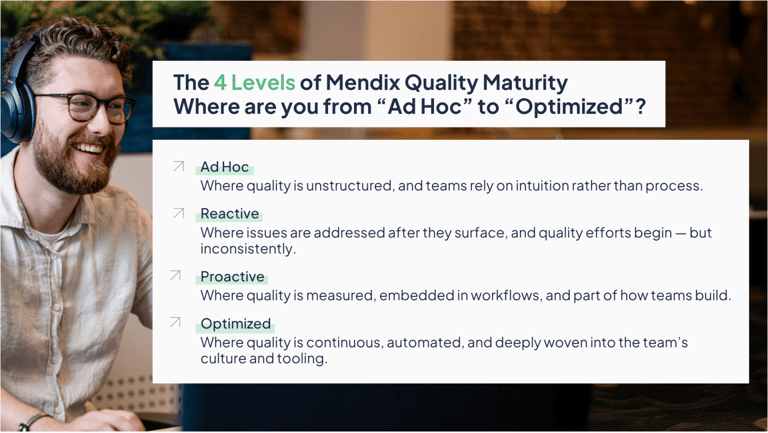
Let’s walk though the 4 levels:
#1 Ad hoc
At this early stage, there’s no structured approach to quality.
Developers mostly rely on experience and gut feeling. UI testing might catch surface-level issues, but there’s little visibility into what’s going on under the hood. As a result, technical debt builds up quietly, and bugs often show up late, sometimes not until users are already in production.
Teams here are moving fast, but without much control.
If you check all the boxes below, your team might be in the Ad Hoc level:
- No formal quality process
- Developers rely on intuition and UI testing
- Technical debt accumulates unnoticed
- Bugs appear late, often in production
#2 Reactive
Some structure starts to emerge. Teams begin reviewing code, usually just before a release, and quality gets attention when problems become too big to ignore.
Issues are addressed, but mostly in response to incidents or breakdowns.
Manual reviews and checklists are used inconsistently, leading to uneven outcomes.
Performance and maintainability vary from app to app, depending on who built them and how closely they were reviewed.
If you check all the boxes below, your team might be in the Reactive level:
- Teams start reviewing code before releases
- Quality issues are addressed when something breaks
- Manual reviews and checklists are used sporadically
- Performance and maintainability vary widely
#3 Proactive
This is where quality starts to become a real part of the development process.
Teams begin tracking metrics like complexity, duplication, and test coverage.
Reviews and code scans are no longer one-off events: they’re built into workflows.
Security and performance criteria are clearly defined and they’re part of the “definition of done.” Teams also begin creating reusable, governed modules to ensure consistency and reduce rework.
If you check all the boxes below, your team might be in the Proactive level:
- Quality metrics are tracked (e.g., complexity, duplication)
- Regular scans and reviews are embedded into workflows
- Security and performance are part of definition-of-done
- Teams begin building reusable modules with governance
#4 Optimized
At the highest level, quality isn’t just a task, it’s a system.
Teams monitor KPIs continuously across their apps and address issues before they become risks.
Quality is enforced automatically via CI/CD pipelines, with tools like Omnext embedded into the process.
Teams don’t just maintain quality, they improve it over time by learning from insights, sharing best practices, and adapting based on feedback.
If you check all the boxes below, your team might be in the Optimized level:
- Quality is monitored continuously
- KPIs are defined per application and enforced automatically
- Omnext is integrated into CI/CD
- Teams share best practices and improve based on insights
Each step up the ladder represents a leap in both capability and culture.
Tools and processes are essential, but they only stick when teams shift their mindset. Mature teams don’t just “check for quality”, they build with quality in mind from the start.
That’s when technical excellence becomes scalable.
Where do you stand?
That’s the key question here. You can assess the maturity level of your organization or team by asking:
- Do we scan our apps regularly for code quality and security?
- Do we act on the insights, or just file them away?
- Are quality standards documented and shared?
- Can we measure improvements over time?
- Are our apps consistently maintainable across teams?
If most of your answers are “no” or “sometimes”, you’re not alone, most teams fall between “Reactive” and “Proactive”.
But getting to “Optimized” is possible!
How to get from Ad hoc to Optimized?
In my personal opinion, the key thing to try and achieve is to build a Culture of Quality in your organization (or at least within your team). Real, lasting maturity comes from how your team thinks and talks about quality on day to day basis.
It’s a mindset shift which starts with a few key habits:
- Lead by example: When architects and leads write clean, maintainable Mendix code, it sets the tone for everyone else.
- Make quality part of the conversation: Bring it into stand-ups, code reviews, and retros. Not as an afterthought — as a priority.
- Celebrate the wins: Don’t just highlight shipped features. Call out improvements in complexity, security, and maintainability too.
- Coach instead of blame: Use insights from tools like Omnext to spark learning, not finger-pointing.
“Alright, wo we have to change our mindset. But how can we can make sure we make our lives easier instead of harder?” Very valid question indeed. Thinking about how to ensure quality is one thing, but having proper tools available makes every job easier!
It all starts with insight
Reaching higher levels of quality maturity isn’t just about wanting to do better, it’s about having the right feedback loops in place.
You need visibility into where your applications stand today, clarity on what to improve next, and a way to embed that process into how your team works.
Tools like Omnext can help with this.
They help translate quality goals into day-to-day practices by measuring what matters (like complexity, duplication, modularity, and security), highlighting deviations from Mendix and industry best practices, and tracking progress over time.
They can also integrate into your existing pipelines and workflows to show where your quality stands over time and make acting on it part of the rhythm.
At the end of the day, you can’t improve what you can’t see.
And building with confidence starts with seeing clearly. Tools like Omnext give you a real-time mirror of your application landscape.
Conclusion
Quality isn’t just about writing clean code, it’s about how teams think, collaborate, and grow together.
The Quality Maturity Model gives Mendix teams a clear path forward. It shows you where you are today, and more importantly, what to focus on next.
Whether you’re just starting to get a handle on technical debt, or looking to fine-tune a fast-growing app portfolio, the journey toward optimized quality is always worth taking.
Step by step, habit by habit, that’s how great teams build great software.
WANT TO KNOW MORE? PLEASE CONTACT US VIA CONTACT@OMNEXT.COM, VISIT WWW.OMNEXT.COM FOR MORE INFORMATION